Not AI for its own sake. Every use case below is adopted intentionally: validated before clinical use, governed by the JPA Code of Practice, aligned with JFDA requirements — and always with a human in the loop.
From molecule to patient — with the pharmacist in the loop at the centre. Click any stage on the wheel to open the course that trains it, or read the detail cards below.
AI accelerates target identification, virtual screening, molecular design and ADMET prediction, and improves clinical-trial design and patient selection.
Safeguard: model validation and honest limits — AI proposes, science disposes.
Process control, predictive maintenance, automated visual inspection and quality analytics — inside GMP and data-integrity rules.
Safeguard: validation and oversight of every AI system in the GMP environment.
Robotic dispensing systems have cut dispensing errors by up to 80% in studied settings — with faster, safer supply.
Safeguard: the mandatory final pharmacist check, loading verification, audits and a manual fallback. Guidance PG-02.
Interaction, dose and allergy checking and AI-assisted order verification catch medication errors before they reach the patient.
Safeguard: CDS is a second check, never the decision-maker; significant overrides are documented. Guidance PG-03.
Large language models draft, summarise and explain — a powerful assistant for medicine questions and patient materials.
Safeguard: verify against trusted sources, watch for hallucinations and region mismatch, and never enter identifiable patient data. Guidance PG-01.
Models flag patients at risk of non-adherence, adverse drug reactions and readmission — so pharmacists intervene before harm.
Safeguard: a flag is a prompt for professional review, never an automatic action; bias is checked across patient groups.
AI-supported remote services and chatbots extend safe pharmacy care to underserved areas of Jordan.
Safeguard: consent, confidentiality, the same standard of care as in person — and a clear escalation path.
AI-assisted ADR case processing, signal detection, regulatory intelligence and demand forecasting keep medicines safe and available.
Safeguard: human judgement on every signal; JFDA reporting obligations always met.
Each note gives rules, a workflow, do/don't lists, worked examples and a quick-reference card for the counter.
The capabilities and documented limits of LLMs, the verification workflow against trusted sources, and the privacy line: no identifiable patient data in public tools.
Operating automated and robotic dispensing safely — stock-loading verification, the mandatory final pharmacist check, override handling, accuracy audits and manual fallback.
Using interaction, dose and allergy checking as a second check — managing alert fatigue, keeping a human in the loop, and documenting significant overrides.
Being honest with patients about where AI supports their care, obtaining consent where required, and answering questions in plain Arabic and English.
The rulebook for every AI decision in Jordanian pharmacy — owned by the profession, aligned with the JFDA, and reviewed as the technology evolves.
Supported by: Interim AI Principles · AI Pilot Protocol Template · Data Governance & Privacy Policy · Vendor DPA & Security Checklist · Member Privacy Notice
The learning ladder runs across the top — awareness for everyone, a practice certificate, then champions. Beneath it, one specialist course per pillar: SAFER at the point of care, SERVE in digital services, GOVERN in the rules, SPARK in research, TRUST with the public.
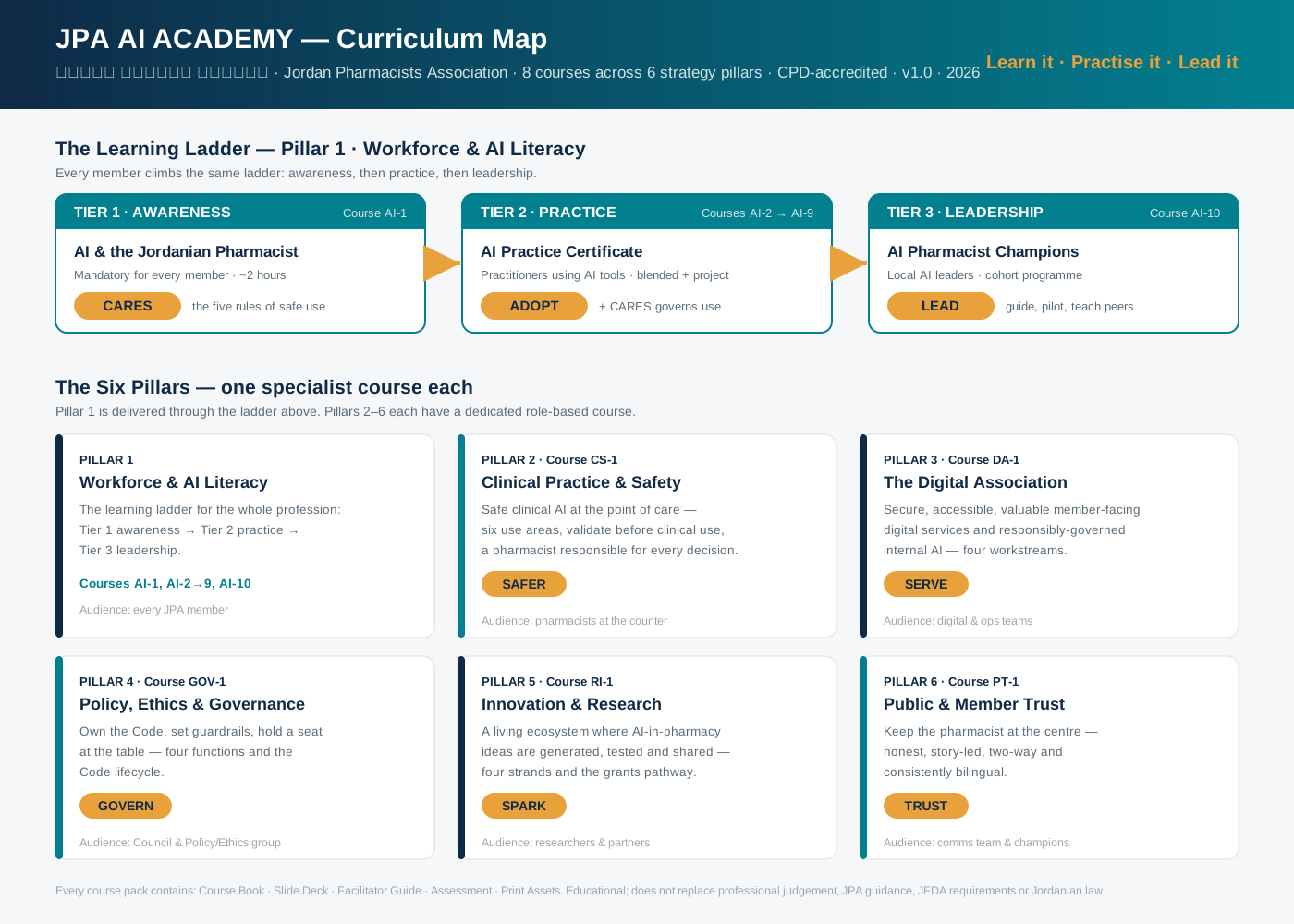
Every use case has a course, a guidance note, and a validation path. Start with the training.
 ⚕
⚕